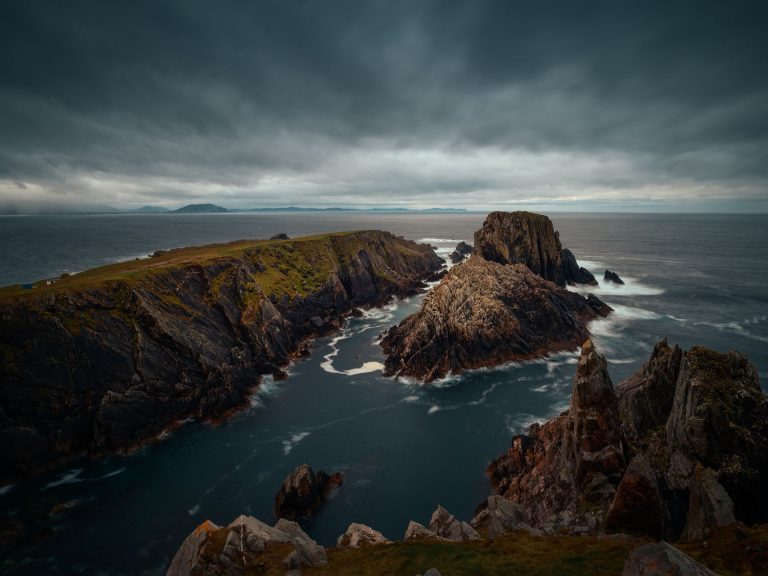
Whether included as part of a wider Wild Atlantic Way tour or visited as a scenic Donegal stop, Malin Head offers exactly the kind of landscape Ireland is famous for: open skies, crashing waves, remote beauty, and unforgettable coastal views.
Where is Malin Head?
Malin Head is located on the Inishowen Peninsula in County Donegal. It is the most northerly point of mainland Ireland and one of the standout Signature Discovery Points on the Wild Atlantic Way.
The area is around one hour from City of Derry Airport, making it accessible for visitors arriving into the north-west before travelling onwards through Donegal and along the Wild Atlantic Way.
Because of its location, Malin Head is often included in private tours that explore Donegal, the Inishowen Peninsula, Derry, the Causeway Coast, or the northern section of the Wild Atlantic Way.
Why Visit Malin Head?
Malin Head is a place that feels remote, powerful, and completely natural. The coastline is rugged and unspoilt, with wide Atlantic views and dramatic rock formations that make it especially popular with photographers, walkers, nature lovers, and visitors looking for a true west-of-Ireland experience.
Tourism Ireland describes Malin Head as the start or end of the Wild Atlantic Way and highlights its coastal scenery, birdlife, and historic interest. Go Visit Donegal also notes the area’s appeal for walking, fishing, swimming, photography, studying rock formations, rare flora, and exploring the wider Inishowen area.
It is not a polished city attraction or a quick photo stop. Malin Head is best enjoyed slowly, with time to take in the landscape, walk along the coast, breathe in the Atlantic air, and appreciate the scale of Ireland’s northern coastline.
Things to See and Do at Malin Head
Visit Ireland’s Most Northerly Point
The main reason many people visit Malin Head is to stand at the most northerly point of mainland Ireland. It is a simple but memorable experience, especially for visitors travelling the Wild Atlantic Way from top to bottom.
The views from the headland are wide, open, and exposed, with the Atlantic stretching out in front of you. On a clear day, it is a fantastic place for photographs, while on a windy day, the full force of the Atlantic makes the visit feel even more dramatic.
Enjoy the Coastal Walks
Malin Head is ideal for visitors who enjoy short scenic walks. The landscape is open and exposed, so even a gentle walk can feel like a real coastal adventure. The walking routes give visitors the chance to see sea cliffs, rock formations, open countryside, and Atlantic views from different angles.
Good footwear is recommended, as ground conditions can vary, especially after rain.
See Banba’s Crown
One of the best-known points at Malin Head is Banba’s Crown, named after a mythical queen of Ireland. This elevated area gives some of the finest views around Malin Head and is often the main stop for visitors exploring the headland.
The old tower at Banba’s Crown is also part of the area’s history, with a watchtower built in the early 1800s during the Napoleonic period.
Look Out for Wildlife and Birdlife
Malin Head is known for birdlife and coastal wildlife. Its exposed location and surrounding sea make it a good place for spotting seabirds, especially for those with an interest in nature and photography.
The experience changes with the seasons, weather, and time of day, which is part of what makes Malin Head such a rewarding place to visit.
Take in the Star Wars Connection
Malin Head also gained international attention as one of the Irish filming locations associated with Star Wars: The Last Jedi. Tourism Ireland has highlighted Malin Head’s connection to the film, along with its natural beauty.
For fans of the films, this adds another reason to visit, but the real star of Malin Head is still the landscape itself.
Malin Head and the Wild Atlantic Way
Malin Head is one of the most important locations on the Wild Atlantic Way because it marks the northern end of the route. The Wild Atlantic Way is promoted as one of the world’s great coastal touring routes, following Ireland’s western seaboard through counties including Donegal, Sligo, Mayo, Galway, Clare, Kerry, and Cork.
Starting a Wild Atlantic Way tour at Malin Head gives visitors a powerful introduction to the route. It immediately sets the tone for the journey ahead: wild landscapes, dramatic coastal roads, small villages, local history, and the Atlantic Ocean never far away.
For those travelling northwards, Malin Head can be the perfect final stop, a place to pause, look out over the ocean, and reflect on the journey along Ireland’s west coast.